
Hangars serve a purpose that extends well beyond functioning as basic shelters for aircraft. They operate as high-performance environments where the roles of engineering precision, operational safety, and visual clarity intersect. These spaces must accommodate a variety of activities—from routine aircraft storage and inspections to complex mechanical maintenance, refueling, assembly procedures, or emergency service dispatch. In each of these contexts, lighting plays a foundational role, not only in enabling visibility but also in ensuring that every movement, tool use, and technical process is performed in an environment that supports accuracy and safety.
The function of hangar lighting is therefore both practical and operational. It directly influences how effectively personnel can work, how securely aircraft can be maneuvered, and how reliably maintenance or safety protocols can be carried out—especially during night shifts or in hangars with limited access to natural daylight. Poor lighting can lead to misjudged distances, eye strain, inspection errors, or even safety hazards. Conversely, a well-executed lighting system enhances situational awareness and supports productivity while complying with relevant aviation and workplace standards.
Evaluating the cost of lighting in such environments involves much more than tallying up the price of fixtures. It requires a detailed understanding of various interdependent elements that influence the overall budget. These include the choice of lighting technology, such as LED versus traditional systems, which has a cascading effect on energy usage, replacement cycles, and environmental impact. Hangar dimensions, including both the floor area and the height of ceilings, determine how many fixtures are needed, how powerful they must be, and how light must be distributed to avoid shadows and hotspots.
Types of Hangar Lighting Fixtures and Their Costs
| Lighting Component | Typical Cost per Unit (USD) | Notes |
|---|---|---|
| LED High Bay (150W) | $120 – $200 | Suitable for hangars with ceilings under 30 feet |
| LED High Bay (400W, High Output) | $350 – $600 | For large hangars with 35–45 ft ceilings; premium models may cost more |
| Fluorescent High Bay (T8, 4-lamp) | $90 – $120 | Lower initial cost but higher long-term maintenance |
| Fluorescent High Bay (T5 HO, 6-lamp) | $150 – $180 | Higher output; better suited for larger hangars |
| Metal Halide/HID (400W–1000W) | $100 – $250 | High energy use; shorter lifespan; phased out in modern installations |
| Motion Sensor (Basic) | $20 – $40 | Per fixture; standalone design |
| Daylight Sensor | $30 – $60 | Adjusts brightness based on natural light |
| Wireless Dimming Module | $80 – $150 | Adds remote control/dimming capability |
| Smart Control System | $150 – $250 per fixture | Includes networking, scheduling, energy monitoring |
| Full Control System (Networked) | $5,000 – $25,000+ per hangar | Depends on hangar size and complexity |
LED High Bay Fixtures
LED high bays have become the most commonly used lighting fixtures in modern hangars due to their high efficacy, long operational life, and low maintenance demands. The cost of a high-quality industrial-grade LED high bay fixture generally ranges from $120 to $600 per unit, depending on the wattage, lumen output, and added features like motion sensors or wireless dimming.
For example, a 150-watt LED fixture suitable for a smaller hangar with a 20- to 30-foot ceiling may cost around $120 to $200. On the other hand, a 400-watt high-output fixture designed for larger hangars with ceilings up to 40 feet can cost $350 to $600. Premium models from leading manufacturers offering better heat dissipation, optics, and corrosion resistance may push costs even higher.
Fixtures are available in both round (UFO-style) and linear formats. Adjustable beam angles and specialized optics for aircraft maintenance or inspection areas also affect pricing. While the upfront costs are higher than legacy systems, LEDs offer significant long-term savings in energy and maintenance.
Fluorescent Fixtures
Though increasingly phased out, fluorescent high bays remain in many older hangars. These fixtures are generally more affordable initially, with unit costs ranging from $80 to $180, depending on the number of tubes and fixture design.
For example, a 4-lamp T8 fluorescent high bay may cost around $90 to $120, while a 6-lamp T5 HO (high output) fixture might reach $150 to $180. However, fluorescent systems require frequent lamp and ballast replacements, especially in large hangars with long operational hours, adding significantly to lifecycle costs.
In cold or variable-temperature hangars, fluorescent lighting performance suffers, and frequent on/off cycles accelerate degradation. These factors are driving many operators to retrofit with LED systems despite the higher initial investment.
Metal Halide and Other HID Fixtures
Metal halide and other HID (High-Intensity Discharge) fixtures were once standard for hangars due to their high lumen output. These fixtures typically cost $100 to $250 per unit, with 400W to 1000W lamps used in most medium to large hangars.
Although cheaper to purchase than LEDs, HID systems have much higher total costs of ownership. They are energy-intensive and inefficient by modern standards. Additionally, the need for regular bulb replacements (typically every 6,000 to 15,000 hours) and long warm-up times diminish their practicality for many modern hangar operations.
A typical 1000W metal halide fixture might cost around $180, but it could consume over $500 in electricity annually per unit, assuming 12-hour daily use at average commercial electricity rates. Maintenance labor and lamp costs further add $30–$60 per fixture per year.
Lighting Controls and Sensors
Advanced lighting control systems improve energy efficiency and adaptability. Basic occupancy or motion sensors can cost between $20 and $60 per fixture, while more integrated systems with wireless dimming, daylight harvesting, or building automation interface capabilities range from $80 to $250 per fixture.
For instance:
- Standalone motion sensors: $20–$40
- Daylight sensors: $30–$60
- Wireless dimming modules: $80–$150
- Smart control systems (networked): $150–$250 per fixture, or $5,000–$25,000+ for full-system installations depending on hangar size and complexity
Though these systems increase upfront costs, they can reduce annual energy consumption by 30–60%, extend fixture lifespan, and help facilities meet LEED or other sustainability certifications.
Factors That Influence Hangar Lighting Costs
Hangar Size and Ceiling Height
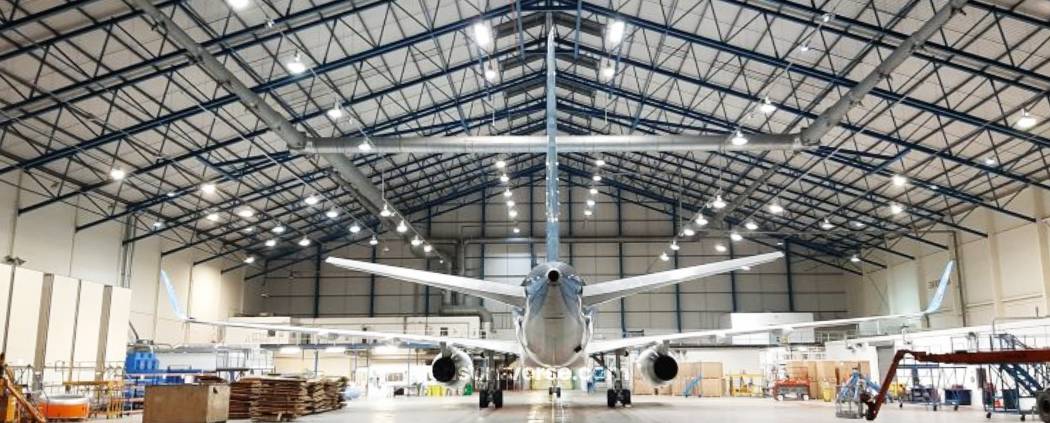
The physical dimensions of the hangar are the foundation upon which all lighting costs are built. A small hangar with a modest ceiling may only require a few high-efficiency fixtures, while a large aviation maintenance facility with soaring ceilings will need a comprehensive system capable of evenly distributing high-lumen light across vast open areas. Ceiling height affects the intensity and spread of each fixture, often requiring more powerful units and sophisticated mounting systems to ensure even illumination.
Type of Lighting Technology
The cost of lighting equipment depends heavily on the type of technology employed. Modern hangars often lean toward LED systems for their energy efficiency and longer lifespans, but older facilities may still use fluorescent or high-intensity discharge (HID) lighting. Each option has different purchase prices, energy demands, lifespans, and maintenance schedules. Upfront costs may differ substantially depending on the lighting source selected, but so too will long-term savings and performance.
Lighting Design and Layout
A well-designed lighting plan ensures even coverage and eliminates shadows or dark zones. Achieving this requires photometric analysis and computer-aided layouts, particularly in facilities where visibility and accuracy are vital. Complex designs that incorporate multiple zones, task lighting, or adaptive controls generally incur higher planning and equipment costs but often result in superior performance and long-term efficiency.
Installation Complexity
The process of installing lighting in a hangar can vary from straightforward to highly intricate. New builds offer the advantage of integrated lighting infrastructure, while retrofits must adapt to existing electrical layouts. Installation may involve scissor lifts or boom trucks to reach rafters, conduit runs for power supply, safety assessments, and alignment of sensors or control systems. Each of these steps adds labor hours and may require specialized expertise or certifications.
Energy Efficiency and Control Systems
Lighting control systems such as motion sensors, daylight harvesting, or programmable dimmers contribute to energy savings and may reduce wear on fixtures. However, these systems come with upfront expenses for hardware and configuration. Depending on the sophistication of the system and whether integration with building automation platforms is required, these features can alter both equipment and installation costs.
Installation Cost Breakdown
Electrical Infrastructure
For new hangars, installing electrical infrastructure typically costs between $4 to $10 per square foot, depending on the complexity of the system and local labor rates. This includes routing power from the main distribution panel, installing conduit runs, mounting control panels, and distributing circuits across the ceiling grid.
In existing facilities, upgrading or adapting current infrastructure adds 10% to 30% more to baseline costs. For a 20,000-square-foot hangar, expect electrical work to range from $80,000 to $200,000. Facilities dealing with hazardous materials or high-voltage machinery may incur additional costs due to stricter code compliance, requiring specialized grounding, circuit protection, and conduit sealing.
Fixture Mounting and Lifting Equipment
Mounting fixtures on high ceilings—often between 30 and 50 feet—requires lifts and rigging equipment. Scissor lift or boom lift rentals typically cost $200 to $500 per day, with labor adding another $65 to $120 per hour per technician.
For a medium-sized hangar requiring 40–80 fixtures, fixture mounting labor can total $10,000 to $25,000, depending on ceiling height, fixture type, and quantity. Additional labor may be needed for fixture aiming, angle adjustments, and bracket fabrication, which can add $2,000 to $5,000 if welding or custom mounts are involved.
Control System Integration
Integrating lighting controls adds both hardware and labor costs. Installation of motion/daylight sensors and wiring to a central controller typically ranges from $1,500 to $5,000 for basic systems in small hangars. For larger or networked control systems, costs may reach $10,000 to $30,000, especially if commissioning by certified integrators or system vendors is required.
Staff training and initial programming/setup typically add $500 to $2,000, especially when control systems must integrate with building automation, energy monitoring, or time-based scheduling.
Testing and Certification
Post-installation testing ensures that lighting levels meet required standards. Photometric validation, fixture-level functional tests, and commissioning checklists typically cost $2,000 to $6,000, depending on hangar size and certification requirements.
Government or military hangars often require formal documentation, safety inspections, and licensed engineer sign-offs, which can add another $3,000 to $10,000 depending on jurisdiction and complexity.
Typical Cost Ranges Based on Hangar Size
Small Hangars
Small hangars, typically under 5,000 square feet, often serve general aviation aircraft or storage functions. For these spaces, a well-designed lighting system using 8 to 12 high bay fixtures may suffice. With relatively low ceiling heights and fewer obstructions, installation labor is also more straightforward.
Total costs for equipment and installation in small hangars can remain within a modest range, depending on fixture quality and control systems. Opting for basic LED fixtures without advanced sensors helps manage the budget, while energy-efficient designs can still offer decent light quality for low-intensity tasks.
Medium Hangars
Medium hangars, ranging from 5,000 to 20,000 square feet, typically serve maintenance or commercial aviation purposes. These facilities require more fixtures and advanced controls to ensure consistent illumination across work zones.
Lighting designs may include multiple rows of high-output LEDs, zone-specific dimming, and occupancy sensors. Installation may involve scissor lift work, more complex wiring paths, and zoning of circuits. Labor costs rise due to increased fixture count and height challenges. Material costs grow proportionally, with premium equipment pushing the total investment higher.
Large Hangars
Large hangars over 20,000 square feet are used for aircraft assembly, servicing wide-body planes, or accommodating multiple vehicles. These environments demand high lumen levels, often exceeding 500 lux across the entire floor area, and involve substantial fixture counts.
Designs typically incorporate hundreds of thousands of lumens, advanced control systems, and redundancies for operational continuity. Installation may span several weeks and involve phased labor, extensive safety coordination, and integration with facility-wide management systems. Equipment costs alone may reach high figures, with installation labor and lift rental compounding the investment.
| Hangar Type | Typical Size (sq ft) | Lighting Technology | Fixture Cost (per unit) | Installation Cost (total) | Total Project Cost (est.) |
|---|---|---|---|---|---|
| Small Hangar | Under 5,000 | LED High Bay | $150 – $400 | $5,000 – $12,000 | $8,000 – $20,000 |
| Fluorescent | $80 – $200 | $4,000 – $10,000 | $6,000 – $16,000 | ||
| HID (Metal Halide) | $100 – $250 | $5,000 – $11,000 | $7,000 – $18,000 | ||
| Medium Hangar | 5,000 – 20,000 | LED High Bay | $200 – $500 | $10,000 – $30,000 | $20,000 – $60,000 |
| Fluorescent | $100 – $250 | $9,000 – $25,000 | $16,000 – $45,000 | ||
| HID (Metal Halide) | $150 – $300 | $10,000 – $28,000 | $18,000 – $50,000 | ||
| Large Hangar | Over 20,000 | LED High Bay | $300 – $700 | $25,000 – $70,000 | $50,000 – $150,000 |
| Fluorescent | $120 – $300 | $20,000 – $60,000 | $40,000 – $110,000 | ||
| HID (Metal Halide) | $200 – $400 | $25,000 – $65,000 | $45,000 – $130,000 |
Energy and Maintenance Cost Impacts
LED Versus Traditional Lighting Technologies
Traditional lighting, such as metal halide (MH), high-pressure sodium (HPS), or fluorescent tubes, often consume more electricity and produce less usable light per watt. For example, a 400-watt HID fixture might deliver around 36,000 lumens but with significant energy losses due to heat dissipation and declining efficiency over time. In contrast, a 150 to 200-watt LED fixture can achieve the same or greater lumen output with less energy input and better beam control.
LED fixtures consistently outperform older technologies in terms of lumen-per-watt efficiency. A well-engineered industrial-grade LED can deliver over 140 lumens per watt, compared to an average of 60 to 90 lumens per watt for HID systems and even less for older fluorescents. The impact of this efficiency becomes even more pronounced in large-scale hangars, especially those operating around the clock, where lighting contributes a major portion of the facility’s energy consumption.
Beyond raw power savings, LEDs offer a higher quality of light, with better color rendering and minimal flicker. This has implications for safety and accuracy, particularly in maintenance hangars where fine-detail work is common. Better visual clarity means tasks can be completed more efficiently, which indirectly reduces labor hours and operational delays.
Another energy-saving aspect of LED systems is their ability to support advanced control strategies. While legacy systems generally operate in an on/off mode, LED lighting can be easily integrated with dimmers, motion sensors, and daylight harvesting systems. These controls further reduce energy usage by ensuring lighting is only used when and where it’s needed.
Reduction in Maintenance Costs and Labor Requirements
Maintenance expenses represent another difference between LED and conventional lighting systems. Traditional HID and fluorescent lamps have relatively short service lives, often requiring replacement every 6,000 to 15,000 hours. This means that over a five- to ten-year period, each fixture may need multiple lamp changes, each one requiring labor, lift equipment, and the cost of replacement parts.
By comparison, LED fixtures offer a rated lifespan of 50,000 to 100,000 hours, depending on the quality of the driver and the thermal management system. This means that many high-quality LED installations can operate for a decade or longer without needing lamp or driver replacement. In high-ceiling hangars, where replacing a fixture involves renting boom lifts or halting operations for safety reasons, this reduction in service frequency translates to measurable cost savings.
Additionally, LEDs are solid-state devices, which makes them more resistant to vibration, temperature fluctuations, and impact damage. These qualities are especially useful in aircraft hangars, where large equipment movement, hangar door operation, and mechanical work introduce frequent environmental stresses.
Replacing or maintaining HID systems also exposes maintenance staff to safety risks due to frequent ladder or lift usage. Reducing the frequency of service minimizes these risks and aligns with workplace safety goals. Moreover, in mission-critical facilities like military or commercial aviation hangars, any downtime for lighting maintenance can affect tight operational schedules. LEDs help avoid these interruptions by providing longer periods of uninterrupted performance.
Thermal Efficiency and Environmental Impact
LED fixtures emit significantly less heat than HID and fluorescent systems, making them more thermally efficient. This has downstream effects on hangar HVAC loads, especially in climate-controlled environments. Less heat generation means reduced strain on cooling systems, leading to further energy savings and prolonged equipment life for HVAC systems.
LED fixtures often contain no hazardous materials like mercury, which is common in fluorescent and some HID lamps. This reduces disposal costs and compliance burdens related to hazardous waste handling. Some regions also offer recycling programs or credits for environmentally friendly equipment, adding another layer of cost benefit for facilities transitioning to LED systems.
Downtime and Operational Disruptions
Unplanned disruptions due to lighting failures can have cascading effects in aviation facilities. A failed fixture in a key work area may halt inspections, delay maintenance procedures, or interfere with hangar traffic flow. In commercial hangars that operate on tight maintenance windows or airline schedules, even short delays may result in operational penalties or lost revenue.
The higher reliability and consistency of LED systems help reduce the frequency of such disruptions. In installations where predictive maintenance or remote monitoring is employed, early warnings about fixture degradation can further reduce the chances of downtime. Some modern LED systems are designed with smart drivers that communicate fixture status to a centralized platform, allowing maintenance to be scheduled during off-hours or planned maintenance cycles.
In retrofit scenarios, the disruption caused by replacing entire lighting systems must also be considered. While the installation of new LED systems is a temporary inconvenience, the long-term stability and reduced service intervals mitigate future disruptions and allow hangar staff to operate with fewer lighting-related concerns.
Cost Recovery Through Utility Rebates
Many utilities offer cash-back rebates for installing high-efficiency fixtures that meet specific standards, such as those set by Energy Star, DesignLights Consortium (DLC), or regional energy efficiency authorities. These rebates may cover a percentage of the fixture cost, the control systems, or even the labor associated with installation.
Tax credits, accelerated depreciation, or green building certifications may also apply, particularly for hangars located in jurisdictions with active sustainability programs. Programs such as LEED (Leadership in Energy and Environmental Design) or the FAA’s Voluntary Airport Low Emissions (VALE) program may reward energy-efficient infrastructure upgrades.
Securing these rebates, however, requires documentation. Utilities often require pre-approval, proof of installation, and validation that the products used meet qualifying specifications. Facilities must be prepared to submit lighting plans, fixture specifications, and invoices. Working with lighting suppliers familiar with rebate programs can streamline this process and maximize financial return.
Return on Investment (ROI) and Payback Period
While LED systems typically carry higher upfront costs compared to traditional lighting, the combined savings in energy and maintenance often produce a return on investment within two to four years, depending on usage intensity and electricity rates. Facilities with extended operating hours, such as aircraft maintenance hangars or round-the-clock service centers, experience faster payback due to the consistent demand for lighting.
ROI can also be influenced by control system optimization. Facilities that implement motion sensing, zone control, and daylight harvesting may further accelerate energy savings, especially in large spaces where full illumination is not needed at all times. Once the payback threshold is crossed, the lighting system becomes a source of ongoing cost savings for the remainder of its operational life.
Even in lower-use hangars, such as those used for aircraft storage or occasional access, LED systems retain long-term value due to reduced service needs and better lighting quality. As energy prices continue to rise in many parts of the world, the relative savings of high-efficiency systems will increase accordingly.
Budget Planning Based on Lifecycle Costs
Facility managers benefit from evaluating lighting projects using a total cost of ownership (TCO) model rather than focusing solely on purchase price. TCO takes into account initial equipment costs, installation labor, energy usage, maintenance frequency, and disposal expenses over the system’s lifespan. For large hangars with hundreds of fixtures, even a small difference in energy consumption per fixture can translate into substantial cost differences over a decade.
An investment in quality lighting also supports operational continuity, staff productivity, and safety. Facilities that adopt a lifecycle-oriented budget approach are better positioned to make informed decisions that balance performance with financial sustainability, reducing the likelihood of surprise costs and future retrofits.
Additional Considerations That Affect Total Cost
Regulatory Compliance
Aviation hangars may be subject to specific lighting regulations from agencies such as the FAA, EASA, or local aviation authorities. Minimum lux levels, fixture certification, color rendering requirements, and emergency lighting provisions can influence the choice and number of fixtures. Complying with these standards may raise equipment and installation costs.
Retrofitting Challenges
Upgrading existing hangars introduces complications not present in new builds. Electrical circuits may require rewiring, ceiling materials may not support modern fixture weights, and existing controls may not be compatible with new systems. Engineering assessments and custom solutions often add design and labor costs to retrofit projects.
Environmental Conditions
Hangars located in humid, dusty, or corrosive environments require specialized fixtures with appropriate ingress protection (IP) ratings. These fixtures are built to withstand exposure and maintain performance in adverse conditions. Their added durability comes with higher price tags, but they prevent frequent failures and safety hazards.
Typical Budget Expectations
Cost of Ownership and Long-Term Considerations
Evaluating Lifecycle Costs
Regardless of hangar size, evaluating lighting costs through the lens of total cost of ownership provides a clearer picture of financial performance. Initial equipment and installation expenses are only part of the equation. Energy consumption, fixture longevity, control flexibility, and maintenance frequency play substantial roles over time.
A budget LED fixture that requires replacement every three years may appear cost-effective at first but leads to greater long-term expense in parts and labor. Conversely, high-efficiency fixtures with 10-year life ratings reduce service interruptions and energy bills, creating better value despite higher purchase prices.
Comparing Energy Use and Utility Rates
Hangars operate on widely varying schedules. Some are used intermittently for storage, while others run continuous maintenance shifts or support logistics operations 24/7. The more hours a lighting system runs, the greater the energy impact—and the more attractive the cost savings of an efficient system become.
Electricity rates vary across regions, but even moderate differences can affect ROI. For example, at $0.12 per kWh, a 20,000-square-foot hangar lit by older 400-watt metal halide lamps could easily incur $15,000 to $20,000 in annual electricity costs. An upgrade to LED could reduce this by 50% or more, creating a favorable return within just a few years.
Budget Planning and Financing Strategies
Phased Implementation Options
For facilities where budget constraints exist, lighting upgrades can often be implemented in stages. A phased approach might begin with priority areas such as maintenance bays, followed by secondary zones like storage areas or mezzanines. Phased projects allow operators to spread costs across multiple fiscal years while gradually improving efficiency.
Leveraging Rebates and Incentive Programs
Many utility companies and local governments offer rebates for energy-efficient lighting upgrades. These can cover a substantial portion of fixture costs or provide credits based on verified energy reductions. Facilities should consult with energy advisors or lighting manufacturers that specialize in rebate optimization to ensure all available incentives are applied.
Return Forecasting and Risk Management
Facilities budgeting for a hangar lighting project should include a forecast of energy savings, maintenance reduction, and expected service life. When compared against the upfront investment, this forecast helps stakeholders determine the breakeven point and overall return on investment. Risk management also involves selecting reputable lighting brands, confirming warranty terms, and planning for spare parts or future expansion.
Tailoring Budgets to Operational Goals
Matching Light Levels to Function
A hangar used primarily for aircraft storage has different lighting needs than a space devoted to mechanical servicing or inspections. Budget allocation should reflect the operational demands of the space. Higher light levels, better color rendering, and dynamic controls are appropriate in task-oriented zones, while general lighting may suffice elsewhere.
Balancing Quality and Performance
Choosing between economy-grade and premium fixtures should not be based solely on unit price. Lighting quality affects everything from visual comfort and safety to productivity and compliance. In aviation environments, where accuracy and precision are valued, higher performance often justifies higher investment. An optimal budget reflects not only the number of fixtures but the performance needed to support core activities.
Conclusion
A well-executed hangar lighting project balances functionality, cost-efficiency, and long-term sustainability. The total cost depends on multiple interrelated factors—hangar size, lighting technology, installation complexity, and energy considerations—all of which shape both the initial investment and the system’s lifecycle performance. While LED systems tend to demand higher upfront costs than traditional options, they often yield better returns over time through lower maintenance needs and reduced power consumption. Whether constructing a new hangar or upgrading an existing one, thoughtful planning around fixture selection, layout design, and control integration allows facility managers to align lighting capabilities with operational demands while managing budget expectations. By approaching the project holistically, with attention to current requirements and future cost trends, it becomes possible to install a system that supports both productivity and reliability within the unique environment of an aviation facility.