

Lighting ensure functionality and safety of warehouses. Understanding the appropriate lux levels for various warehouse zones helps create an environment that supports productivity, accuracy, and comfort. Warehouses serve multiple functions, from receiving and storage to packing and shipping, each with distinct lighting needs. The amount of illumination, measured in lux, affects how tasks are performed and can influence operational efficiency and worker wellbeing.
Understanding Lux and Its Role in Warehouse Lighting
Lux is a measurement that represents the intensity of light falling on a surface, reflecting how bright that surface appears to the human eye. It is defined as one lumen per square meter, providing a standardized way to assess illumination levels in any environment. This measurement is fundamental in lighting design because it directly relates to how well a space is lit, influencing both visibility and comfort.
Unlike lumens, which measure the total amount of light emitted by a source regardless of where it lands, lux focuses on the actual illumination experienced on a given surface area. This distinction is essential because two light sources with the same lumen output can create vastly different lux levels depending on fixture placement, beam angle, distance from the surface, and environmental factors such as wall color and reflectivity.
In warehouses, lux levels must be thoughtfully determined to align with the wide range of activities that occur within the facility. Tasks that involve detailed work, such as quality control inspections or administrative duties, demand higher lux values to support precision and reduce eye strain. Conversely, zones where broad visibility of large items suffices, like bulk storage or transit aisles, can operate comfortably with lower illumination levels.
The role of lux extends beyond mere brightness; it also influences safety and productivity. Adequate lighting minimizes the risk of accidents, helps workers locate and handle materials efficiently, and reduces fatigue over long shifts. However, applying more light than necessary can lead to glare, wasted energy, and discomfort. Therefore, understanding how to measure and apply appropriate lux levels tailored to each warehouse area helps balance operational needs with energy management and worker well-being.
Furthermore, the complexity of warehouse environments introduces additional considerations when determining lux standards. High ceilings, shelving heights, and the presence of machinery or automated systems all affect how light disperses and how much illumination reaches critical surfaces. Seasonal changes and variations in natural daylight availability may also impact lighting requirements. Integrating these factors into the design process ensures that lux levels remain consistent and effective throughout the year.
Recommended Lux Standards for Warehouse Environments
| Warehouse Area | Sub-Area / Activity | Recommended Lux Level | Notes / Purpose |
|---|---|---|---|
| General Storage Areas | High Rack Storage | 150 to 200 lux | Compensates for elevated fixture heights and vertical visibility needs. |
| Narrow Aisle Storage | 120 to 160 lux | Ensures visibility in confined pathways and minimizes shadows between racks. | |
| Automated Storage and Retrieval Systems (ASRS) | 180 to 220 lux | Supports both machine vision systems and human oversight with uniform lighting. | |
| Bulk Storage / Pallet Areas | 100 to 150 lux | Provides safe navigation and product identification without excessive brightness. | |
| Receiving and Shipping Zones | Loading Docks | 200 to 300 lux | Supports visibility during unloading/loading, compensates for variable daylight. |
| Conveyor Belts | 250 to 300 lux | Ensures clear visibility of products for scanning and sorting tasks. | |
| Packaging Stations | 300 to 500 lux | Facilitates accuracy in labeling, sealing, and quality checks. | |
| Office and Administrative Areas Within Warehouses | General Lighting for Office Spaces | 350 to 500 lux | Provides comfortable illumination for desk work and computer use. |
| Conference Rooms | 300 to 500 lux | Supports meetings, presentations, and collaborative discussions. | |
| Collaborative Zones / Break Areas | 250 to 350 lux | Offers a relaxed yet adequately lit environment for informal tasks. | |
| Quality Control and Inspection Stations | Detailed Inspection Tasks | 500 to 1000 lux | High illumination needed to detect defects and ensure product quality. |
| Pathways, Aisles, and Safety Zones | Intersections and Cross Aisles | 150 to 200 lux | Enhanced visibility to reduce collision risks and improve navigation. |
| General Pathways and Aisles | 100 to 150 lux | Clear visibility for safe movement and hazard avoidance. | |
| Emergency Exits and Evacuation Routes | 5 to 20 lux (emergency lighting) | Maintains safe egress visibility under power failure or emergencies. |
The recommended lux standards for warehouse environments vary depending on the specific function and activities performed within each area. These standards are designed to ensure adequate visibility for safe operations, efficient task completion, and comfortable working conditions. Proper lighting enhances accuracy in tasks such as picking, inspection, and packaging while reducing the risk of accidents in pathways and loading zones. Adhering to established lux recommendations supports both productivity and energy efficiency across the facility.
Lux Levels for General Storage Areas

Storage areas in warehouses are among the most expansive and frequently used zones. These spaces generally consist of shelving units, pallet racks, or bulk storage stacks where workers regularly locate, pick, and place inventory items. Lighting in these areas must strike a balance between providing sufficient visibility for accurate identification of products and avoiding overly bright conditions that could cause glare or discomfort.
The recommended lux levels for general storage typically fall within the range of 100 to 150 lux. This range supports safe navigation through aisles and clear recognition of labels and packaging without resulting in excessive energy consumption. For example, a typical pallet storage area illuminated at 120 lux allows workers to distinguish between different types of boxes or pallets easily, while also preventing eyestrain during repetitive tasks.
Several factors influence the effectiveness of lighting in storage zones. The height and width of aisles, the height of the racks, and the reflectance of walls and ceilings all affect how light disperses. Warehouses with narrow aisles and tall racks often face challenges with shadows, which can obscure items and increase the risk of errors or accidents. Achieving uniform illumination requires strategic fixture placement and selection.
Using lighting fixtures with adjustable beam angles helps focus light directly down storage aisles, reducing spill light and over-illumination of adjacent zones. This targeted approach not only improves visibility but also contributes to energy efficiency by limiting wasted light. Additionally, the color temperature of lighting in storage areas usually ranges between 3500K and 5000K, providing a neutral to cool white light that enhances color differentiation without feeling harsh.
Considerations for High Rack Storage

When storage racks exceed two meters in height — common in many modern warehouses that maximize vertical space — lux requirements increase to compensate for the greater distance between lighting fixtures and working surfaces. In high-bay storage, lighting must penetrate deeper into racks and aisles to maintain adequate brightness levels on lower shelves, where most picking activities occur.
High-bay warehouses often employ powerful LED fixtures mounted at heights ranging from 8 to 15 meters or more. These fixtures typically deliver a luminous efficacy exceeding 120 lumens per watt, allowing the installation of fewer units while achieving higher lux levels. The recommended illumination in these areas generally falls between 150 and 200 lux. For instance, a 12-meter high rack area illuminated at 180 lux provides enough light for workers using forklifts or picking tools to identify products accurately and safely.
Specialized optics and reflectors are also used to control beam spread and minimize glare, which can be problematic at higher mounting heights. Additionally, consistent light distribution is important to prevent dark spots that could obscure important labels or create unsafe conditions. Lighting designers often rely on simulation software to model these environments, ensuring optimal fixture selection and positioning.
Lux Levels for Narrow Aisle and Automated Storage Systems
Many warehouses now incorporate narrow aisles to maximize storage density, sometimes combined with automated storage and retrieval systems (AS/RS). These systems use robotic cranes or shuttles to pick and place inventory, requiring well-designed lighting both for machine sensors and human operators who oversee operations.
Lux levels in narrow aisles typically range from 150 to 250 lux. This elevated lighting supports both visual inspection and the proper functioning of automated guidance systems. The confined nature of narrow aisles means that shadows and glare can have a greater impact on visibility, so light uniformity is a priority.
For AS/RS zones, lighting must also accommodate the technical needs of machine vision cameras, which often require specific light intensities and spectral qualities. Light sources with a high Color Rendering Index (CRI above 80) help ensure that colors and labels are accurately captured by cameras, facilitating efficient inventory management and reducing errors.

Maintaining Lighting Quality in Storage Areas
Over time, lighting performance can degrade due to dust accumulation, aging fixtures, or changes in warehouse layout. Regular maintenance and lighting audits help sustain recommended lux levels, particularly in storage zones where visibility directly affects operational accuracy.
Periodic cleaning of fixtures and replacement of lamps ensure that the designed lux levels are maintained. Additionally, upgrades to LED technology often provide opportunities to improve lighting uniformity and energy efficiency while achieving consistent lux standards. Automated lighting controls such as occupancy sensors and daylight dimming systems can further optimize illumination, responding dynamically to warehouse activity and natural light availability.
Illumination in Receiving and Shipping Zones

Receiving and shipping zones serve as the bustling gateways of a warehouse, where goods are constantly in motion — being unloaded from trucks, inspected for accuracy and quality, repackaged, and dispatched to their next destination. The lighting requirements in these areas differ considerably from other warehouse sections due to the combination of detailed visual tasks and the need for rapid movement and workflow efficiency. These zones typically demand lux levels ranging from 200 to 300 lux, a range that enhances visibility and precision without causing excessive glare or discomfort.
Higher illumination in receiving and shipping supports several operational objectives. It reduces errors such as mislabeling or incorrect product placement, which can disrupt inventory tracking and shipment accuracy. Additionally, good lighting aids in the quick identification of damaged goods, allowing for prompt corrective actions. The enhanced visibility also contributes to safety by illuminating loading docks, conveyor belts, packaging stations, and staging areas where workers and machinery operate in close proximity.
Lighting Challenges in Loading Docks
Loading docks stand out as some of the most visually complex and demanding areas within a warehouse environment. Unlike the more controlled interior sections of a facility, loading docks often bridge the gap between indoor and outdoor spaces, making them susceptible to rapidly changing lighting conditions throughout the day. Large overhead doors, which are frequently left open to accommodate truck traffic, allow varying amounts of daylight to enter the space. This natural light can shift dramatically based on the time of day, weather, and even the angle of the sun, introducing stark contrasts that complicate artificial lighting design.
Additionally, the presence of incoming trucks, trailers, dock levelers, and shelters often blocks or absorbs light, casting deep shadows across critical working surfaces. These shadows can obscure pallet edges, stray packaging, or spills, creating tripping hazards or opportunities for product damage during handling. Abrupt transitions between bright outdoor sunlight and dim interior lighting can also momentarily disrupt a worker’s vision, increasing the potential for accidents as eyes struggle to adjust to rapidly changing light levels.
To address these concerns, lighting designers implement several strategies aimed at maintaining consistent illumination across the entire dock area. One approach involves using high-output LED fixtures equipped with specialized optics that direct light exactly where it’s needed, such as the edge of the loading platform or the interior of a trailer. These fixtures help fill in shadows and reduce contrast between sunlit and shaded areas, supporting clear visual recognition of products, paperwork, and floor obstructions.
Dynamic control systems are also a major asset in loading dock environments. Adjustable fixtures connected to motion sensors or occupancy detectors enable lighting to respond to real-time activity. When a trailer backs into the dock and workers begin unloading, the system automatically increases lux levels to ensure precise visibility. Once the area is clear, the lights dim down or switch off, conserving energy without sacrificing readiness for the next operation.
Many facilities take advantage of daylight harvesting systems in loading docks as well. Light sensors monitor ambient daylight levels and adjust artificial illumination to maintain a steady overall lux value. For instance, if bright afternoon sunlight pours into the dock through an open door, the sensors reduce the LED output to avoid over-lighting and wasting energy. As daylight fades or is blocked by a trailer, the artificial lights ramp up to keep illumination stable, often maintaining target levels around 200 to 300 lux throughout all operational periods.
Properly managing glare is another concern. Smooth concrete floors, metallic dock plates, and reflective packaging materials can bounce light into workers’ eyes, especially under powerful fixtures. Choosing fixtures with diffusers or shielding elements helps soften the beam, directing light downward and across the working plane instead of outward at eye level. The result is a more comfortable and visually balanced environment where employees can safely and confidently maneuver forklifts, hand trucks, and pallet jacks.
Ultimately, addressing the lighting challenges of loading docks requires a holistic approach that combines fixture selection, strategic placement, intelligent controls, and an understanding of how natural and artificial light interact. This careful planning ensures that docks remain well-lit under all conditions, reducing risks and supporting efficient loading and unloading processes day and night.
Optimizing Visibility on Conveyor Belts and Packaging Stations
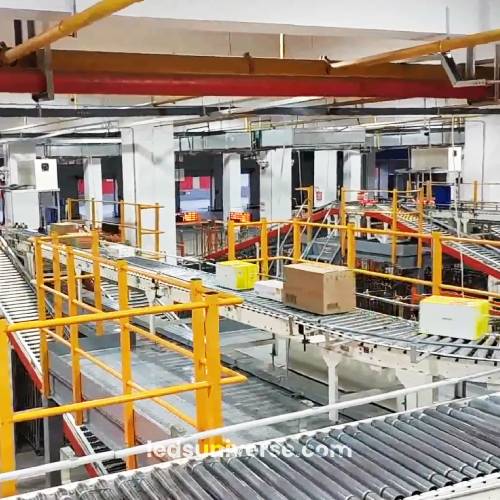 Within the receiving and shipping areas of a warehouse, conveyor belts and packaging stations form the backbone of product handling and order preparation. These are locations where meticulous work happens continuously — reading small print on labels, scanning barcodes, matching item numbers, taping boxes, wrapping pallets, and double-checking contents against shipping documents. Such detailed activities place considerable visual demands on employees, making the quality and consistency of lighting in these zones a top concern.
Lux levels for conveyor and packaging workstations often push toward the higher end of the general recommendation, frequently reaching or slightly exceeding 300 lux. This heightened illumination reduces the likelihood of misreading labels or overlooking packaging flaws, supporting accurate sorting and dispatch. In high-volume distribution centers, these lux standards can directly influence throughput by minimizing slowdowns due to mislabeling or repackaging errors, which might otherwise disrupt the entire supply chain downstream.
Consistent, uniform light is a standout requirement in these areas. Conveyor systems often have moving surfaces, overlapping packages, or irregular shapes that can create unexpected shadows. Uneven lighting risks hiding small tears in packaging, misplaced shipping stickers, or partially obscured barcodes, potentially leading to mistakes in outbound shipments. To combat this, lighting layouts in these zones are typically designed to overlap beams from multiple fixtures, eliminating dark patches and ensuring an even wash of light across conveyor belts and work surfaces.
Fixtures equipped with diffusers or frosted lenses are widely used in packaging areas. These elements scatter the light, softening harsh edges and lowering the contrast between bright and shaded sections of a package. This design approach also reduces glare that might bounce off glossy labels, stretch film, or stainless steel equipment, helping workers maintain concentration without squinting or repeatedly adjusting their position to get a better view.
Color temperature plays a supporting role in visual performance. Adjustable or fixed lighting between 4000K and 5000K provides a balanced, neutral white illumination that keeps details crisp and colors accurate. Workers sorting products by color-coded labels or verifying multi-part kits benefit from this clarity, as warmer lights around 3000K can introduce slight yellowish tones while cooler lights above 6000K may render packaging with a bluish cast, subtly distorting true colors and causing momentary confusion.
Special Considerations for Night Operations and Shift Work
Warehouses that run around the clock face unique lighting demands once daylight disappears. During night operations, artificial lighting becomes the sole source of illumination, making its quality and consistency even more crucial. In receiving and shipping zones where tasks involve rapid movements and detailed visual work, maintaining lux levels between 250 and 300 lux is common practice. This higher illumination threshold helps compensate for the lack of natural light and reduces fatigue that can build up over long night shifts.
In some high-throughput distribution centers, lux levels may even be set closer to 350 lux during nighttime loading and sorting activities to maintain the same visual comfort workers experience during the day. By preserving consistent brightness throughout all shifts, facilities minimize the chance of visual adaptation delays that occur when workers move between areas of differing light intensity. This steady illumination directly supports concentration and reduces the risk of mistakes during picking, scanning, and labeling tasks.
Energy-efficient LED systems with dimming capabilities are especially useful in these continuous operations. LEDs not only achieve the targeted lux levels with lower wattage but can also be finely tuned to provide optimal brightness and color temperature — often around 4500K — to keep workers alert and reduce strain. Dynamic controls allow the lighting to drop to 100 to 150 lux during low-traffic periods or partial shutdowns, conserving energy without fully darkening critical zones.
Emergency lighting systems are another foundational element. Regulations typically require emergency fixtures to deliver at least 5 to 15 lux in aisles and exit routes during power outages, ensuring workers can evacuate safely. In high-activity receiving and shipping areas, emergency lighting is often designed to temporarily maintain closer to 50 lux to prevent abrupt darkness that could leave forklifts and workers stranded mid-task. These systems integrate seamlessly with normal operations, automatically activating when primary power is lost, sustaining visibility until full lighting is restored or evacuation is complete.
Energy Efficiency Strategies in Receiving and Shipping Lighting
Because receiving and shipping zones can account for a substantial share of a warehouse’s operational hours, they also represent a major opportunity for reducing energy costs. Installing LED fixtures with high luminous efficacy — often exceeding 130 lumens per watt — allows facilities to meet demanding lux standards without excessive electrical load. For example, replacing outdated metal halide fixtures might cut energy consumption by more than half while still achieving 300 lux on working surfaces.
Advanced lighting controls significantly enhance these savings. Daylight harvesting systems equipped with sensors adjust artificial lighting based on the amount of natural light entering through dock doors or windows. If afternoon sunlight raises local lux levels to 250 lux on its own, automated systems dim LED fixtures to maintain a steady target of 300 lux instead of overshooting it. This approach avoids both wasted energy and potential discomfort from excessive brightness.
Time-based scheduling is another effective method, programming lights to step down to 100 lux or lower during planned breaks or periods when fewer dock doors are active. Zoning divides large receiving and shipping areas into smaller segments that illuminate only when needed, ensuring that light follows the workflow. For instance, if only three loading docks out of twelve are in use during early morning hours, sensors and smart controls keep the lux levels high in those zones while maintaining minimal illumination in idle areas.
Combining these strategies with thoughtful fixture placement — such as aligning luminaires directly over conveyor lines or packing tables — ensures that light is delivered precisely where tasks occur, reducing waste and supporting sustainability initiatives. Together, these energy management techniques allow warehouses to uphold recommended lux levels for productivity and safety while achieving meaningful long-term cost reductions.
Office and Administrative Areas Within Warehouses
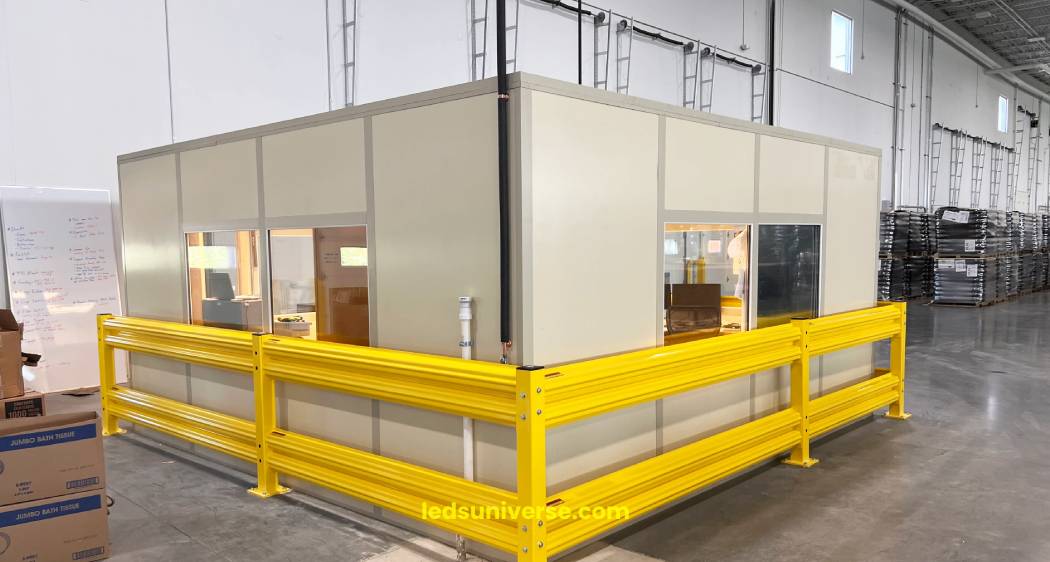
While the bulk of a warehouse focuses on storage, handling, and logistics, many facilities also house dedicated office spaces that support the operational side of the business. These offices handle administrative tasks such as inventory tracking, shipping documentation, payroll, customer communication, and managerial oversight. Because the nature of work in these areas involves detailed visual tasks, the lighting requirements are more demanding than those on the warehouse floor.
Lux standards for office and administrative areas typically range from 300 to 500 lux, significantly higher than the 100 to 200 lux found in general storage zones. For example, a warehouse accounting office might maintain an average of 350 lux to comfortably support reading invoices and data entry on screens, while a conference or training room could be lit closer to 400 lux to ensure participants can easily review printed materials and view presentations. In areas where especially detailed paperwork or inspection happens, such as signing multi-page contracts or preparing compliance documentation, illumination may reach 500 lux to reduce visual fatigue and maintain accuracy over long periods.
Optimizing General Lighting for Office Spaces
General illumination throughout warehouse offices is commonly provided by overhead fixtures that deliver broad, uniform light. LEDs with a color temperature in the range of 4000K to 5000K are often selected, as their neutral to slightly cool white light helps sustain alertness and creates a clean, professional environment. Maintaining an even spread of light ensures that there are no overly bright hotspots or dim corners, which can strain the eyes when moving between different tasks or desk areas.
In open-plan office spaces that house multiple workstations, light levels generally average around 350 to 400 lux. This illumination is adequate to clearly view paperwork, maintain productivity on screens, and facilitate face-to-face discussions without feeling overly harsh. For additional comfort, fixtures with low glare ratings and diffusers help minimize reflections on computer monitors and polished surfaces.
Conference Rooms and Collaborative Zones
Conference rooms, meeting areas, and training spaces within a warehouse office benefit from flexible lighting strategies. These zones often incorporate dimmable overhead fixtures that can shift from 300 lux during informal discussions to 500 lux or higher when participants need to review printed handouts or technical schematics. Having this adjustable range reduces glare on projection screens and enhances the comfort of participants during long sessions.
Integrated controls in these spaces might allow different lighting scenes, such as a bright setting for collaborative workshops and a lower level for presentations involving screens. This versatility ensures that light always supports the specific function underway, maintaining both visual clarity and attentiveness.
Energy Efficiency and Smart Controls in Office Lighting
Because office and administrative zones operate many hours per day — often longer than some warehouse sections — energy efficiency remains a priority. Using LED fixtures with luminous efficacy above 120 lumens per watt helps keep electricity costs down while maintaining target lux levels. Occupancy sensors can reduce lighting to 100 lux or turn it off entirely when rooms are empty, automatically ramping back to 400 lux or more when people return. Daylight sensors near windows also adjust artificial lighting based on natural light input, keeping overall illumination steady at desired levels such as 350 lux throughout the workday.
By integrating these advanced controls with carefully planned general and task lighting strategies, warehouse offices achieve an environment where productivity and visual comfort are sustained hour after hour. Properly designed lighting systems support detailed clerical work, screen use, and collaborative discussions alike, maintaining a bright, balanced atmosphere that enhances efficiency and reduces fatigue.
Quality Control and Inspection Stations
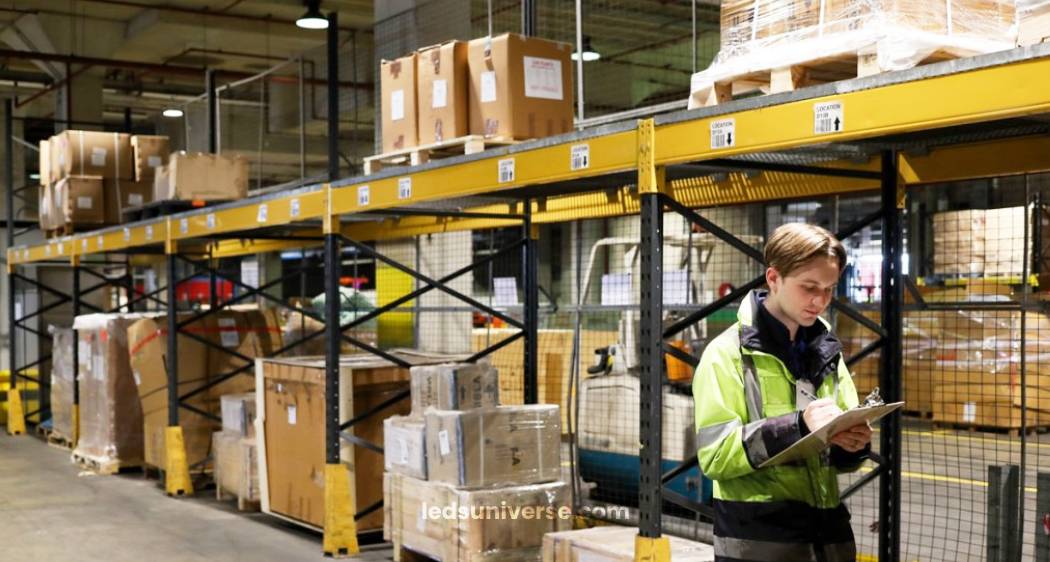
Quality control and inspection areas within a warehouse play a vital role in ensuring that products meet required standards before they move to customers or downstream processes. Unlike general storage or shipping zones, these areas demand a much higher degree of visual precision. Workers often examine products for surface defects, verify labels and barcodes, confirm packaging integrity, or inspect small parts and assemblies. Because even subtle flaws can compromise the value or safety of goods, lighting systems in these zones are designed to achieve significantly higher lux levels, ranging typically from 500 to 1000 lux.
The exact target illumination often depends on the nature of inspections. For instance, verifying printed packaging graphics or checking barcodes for clarity might comfortably use 500 to 600 lux. More rigorous tasks, such as inspecting electronics components, painted finishes, or fine mechanical parts, may call for illumination closer to 800 to 1000 lux to highlight surface variations and color differences that would otherwise be missed under standard warehouse lighting.
Uniform Lighting to Minimize Shadows
Uniformity is a primary goal in quality control zones. Harsh contrasts or patchy lighting can hide scratches, dents, or misprints, leading to overlooked defects that eventually reach customers. To avoid this, lighting layouts often use multiple fixtures arranged to overlap beam patterns, creating a consistent wash of light across workbenches and inspection tables. In many cases, designers aim for a uniformity ratio (minimum lux divided by average lux) above 0.7, ensuring no areas dip below acceptable brightness.
Diffused light sources are commonly employed to soften the illumination, scattering it evenly and reducing harsh edges that cast distracting shadows. For example, LED panel lights with frosted covers or linear fixtures with wide beam distributions can maintain 700 lux across a broad table surface without producing glaring hotspots.
Adjustable Task Lighting for Detailed Inspections
While overhead lighting establishes a bright general environment, adjustable task lights provide additional illumination exactly where it’s needed. These fixtures often include flexible arms or pivoting heads that allow workers to direct beams onto specific parts of a product. Local lux levels under such task lights can easily reach 1200 to 1500 lux when required, ideal for scrutinizing intricate features such as tiny welds, delicate threads, or intricate electronics solder joints.
Task lighting also enhances ergonomics by allowing inspectors to position light sources to minimize reflections or glare from glossy surfaces. This not only protects visual comfort but also speeds up the inspection process by reducing the time spent repositioning objects to see them clearly.
Maintaining High Lux Levels Over Time
Quality control areas often operate throughout the day and sometimes around the clock. As a result, maintaining consistent lux levels requires proactive upkeep. Dust buildup on fixture lenses or the gradual depreciation of LED output can lower light levels below their design targets. Facilities commonly schedule periodic light measurements, using lux meters to verify that work surfaces still meet the 500 to 1000 lux range. If readings fall below about 10% of the intended value, cleaning or replacement of fixtures is performed to restore optimal conditions.
Combined with modern dimmable systems and programmable controls, these measures help sustain a well-lit environment that continuously supports defect detection and product consistency, reducing costly returns or rework.
Pathways, Aisles, and Safety Zones
 Walkways, aisles, and designated safety zones form the backbone of safe movement throughout a warehouse. These thoroughfares ensure that workers can efficiently navigate between storage racks, shipping docks, offices, and production areas without unnecessary delays or hazards. Proper illumination in these spaces directly supports accident prevention and keeps daily operations running smoothly, even under busy or high-traffic conditions.
The recommended lux levels for general warehouse pathways and aisles typically range from 100 to 150 lux. This brightness is sufficient for workers to identify obstacles, read safety signage, and recognize floor markings such as directional arrows or hazard lines. For example, main aisles used by both pedestrians and forklifts may be illuminated to 140 lux, ensuring visibility of cross-traffic and parked pallets. Narrow or less frequently used walkways might be designed closer to 100 lux while still maintaining safe clarity.
Enhanced Lighting at Intersections and Cross Aisles
In many warehouses, intersections where multiple aisles converge or where forklifts cross pedestrian paths are points of heightened risk. To reduce collision chances and improve situational awareness, lighting designers often specify slightly higher lux levels in these junction zones, typically between 150 and 200 lux. This added brightness makes moving objects easier to spot from greater distances and highlights safety markings or stop signs painted on the floor.
Fixtures with wide beam spreads are commonly positioned directly above these intersections, bathing the area in even illumination and minimizing harsh shadows that might otherwise hide stray pallets or packaging debris.
Illuminating Emergency Exits and Evacuation Routes
Emergency pathways, including clearly marked exits and designated egress routes, carry specific lighting requirements that go beyond normal operational safety. Under everyday conditions, these areas often align with general walkway standards, maintaining 120 to 150 lux to guide employees safely through the warehouse. However, in the event of a power outage or emergency evacuation, dedicated emergency lighting systems take over to sustain a minimum visibility threshold.
Most building codes require that exit routes remain lit to at least 5 to 10 lux during an emergency. Many modern warehouses design these systems to maintain closer to 20 lux, ensuring that all directional signs, steps, and floor markings are unmistakable even under backup power. This extra illumination is especially beneficial in large facilities where exits may be hundreds of feet from the working area.
Safety Markings and Floor Detail Visibility
Warehouses frequently use painted floor markings or adhesive tapes to designate pedestrian lanes, forklift paths, staging areas, and hazard zones. Keeping these visual cues clearly visible requires maintaining consistent lux levels across the floor plane. Lighting systems that deliver 120 to 150 lux help workers instantly identify safe walking paths and avoid unauthorized zones or loading areas.
Reflective or photoluminescent tapes are sometimes combined with adequate overhead illumination to further enhance visibility. For example, reflective strips can be visible with as little as 80 lux, but when paired with a well-maintained lighting system delivering around 140 lux, they stand out distinctly even in peripheral vision, reducing the likelihood of accidental encroachment into hazardous areas.
Adapting Lighting for Mixed Traffic Zones
Many aisles serve both pedestrians and equipment like forklifts or pallet jacks. In such mixed-use lanes, slightly higher illumination, often maintained around 150 to 180 lux, improves reaction times and helps workers gauge distances to moving machinery. This brightness is enough to clearly see approaching vehicles and allows forklift operators to identify people or obstacles from further away, facilitating smoother shared use of space.
Specialized Areas and Their Lighting Needs
Many modern warehouses extend beyond conventional storage and shipping functions, incorporating specialized zones tailored to unique operational requirements. These areas frequently involve distinct environmental conditions, advanced technologies, or stricter regulatory oversight, all of which influence their lighting strategies. Because of the different activities performed within these zones, recommended lux levels and fixture specifications vary considerably from general storage or handling areas.
For example, cold storage environments used to preserve perishable goods must address not only illumination but also equipment resilience to low temperatures. In these spaces, recommended lux levels generally fall between 150 and 200 lux. This brightness is adequate to safely maneuver pallets and read labels without causing excessive energy consumption or heat output, which could disrupt refrigeration efficiency. Lighting fixtures in cold rooms typically include specialized LED housings rated for subzero operation, ensuring consistent output even when ambient temperatures drop to -30°C or below.
Hazardous materials storage, on the other hand, often demands both robust fixtures to handle corrosive or flammable environments and illumination levels tailored to enhance safety signage and labeling. Lux levels here might be maintained around 200 to 250 lux to clearly highlight warning labels, spill kits, and emergency pathways, reducing the chance of mishandling or unnoticed leaks.
Automated picking and robotic handling zones represent another layer of complexity. These areas frequently rely on machine vision systems for scanning barcodes, aligning items, or verifying product shapes. Uniform, shadow-free illumination is critical to the reliable operation of these systems. Lux levels in such zones are often calibrated to 250 to 300 lux to support both human oversight and automated sensors. Specialized optics and diffusers are used to minimize glare and reflections that could interfere with scanners or cameras.
Lighting in Cold Storage and Freezer Environments
Cold storage illumination presents several technical challenges beyond simple brightness. The extreme temperatures can cause traditional lighting technologies, such as fluorescent tubes, to fail or deliver inconsistent output. LED fixtures designed for low-temperature use maintain stable lumen output and avoid long warm-up times, ensuring that the workspace instantly reaches its target illumination of 150 to 200 lux when switched on.
To reduce heat contributions that force refrigeration systems to work harder, these LEDs often operate at high efficiencies of 130 lumens per watt or more. This allows a warehouse to achieve target lux levels across shelving, loading areas, and walk-in freezers without significantly impacting cooling demands.
Explosion-Proof and Hazardous Area Lighting
Warehouses handling flammable chemicals or volatile dusts frequently require explosion-proof lighting systems that meet strict certification standards. While the structural design of fixtures is paramount for safety, achieving appropriate lux levels remains equally vital. Many of these hazardous storage or blending areas are maintained at 200 to 250 lux to ensure workers can read safety data sheets, hazard labels, and instructions without ambiguity.
Additional localized task lighting may elevate illumination to 300 lux at workstations where precise measurements or manual transfers occur. These setups reduce the chance of costly or dangerous mistakes by supporting clearer visual confirmation of materials being handled.
Impact of Color Rendering Index (CRI) on Warehouse Lighting
While lux measures the brightness or quantity of light reaching a surface, the Color Rendering Index (CRI) quantifies how well a light source reveals colors compared to natural sunlight. This factor is especially relevant in specialized warehouse areas where distinguishing between colors is critical. For example, quality control stations inspecting painted products or multi-color packaging may demand CRI values of 90 or above to ensure even subtle shade differences are noticeable.
In automated environments, accurate color rendition can also impact machine vision systems calibrated to detect specific label hues or packaging patterns. In such settings, fixtures are often selected to provide both 280 to 300 lux of illumination and a high CRI to ensure reliable visual processing by cameras and sensors.
Human Comfort and Color Quality in Specialized Spaces
Even in cold storage or hazardous environments, workers spend considerable time reading labels, scanning inventory, or verifying shipments. Lighting systems with CRI ratings above 80 help maintain comfortable color perception, reducing eye strain and errors. For example, being able to distinguish between similar shades of blue and green labels can prevent shipping or picking mistakes, especially under fast-paced conditions where employees rely on quick visual cues.
Color temperature also contributes. While most general warehouse areas use 4000K to 5000K lighting to maintain alertness and provide a neutral appearance, some specialized inspection areas might shift slightly cooler to 5500K to 6000K to replicate daylight and expose fine surface inconsistencies.
Energy Efficiency Considerations Alongside Lux Standards
Meeting recommended lux levels throughout a warehouse is vital for safety, accuracy, and productivity, but sustaining these standards over vast floor areas can drive substantial energy expenses if not carefully managed. As warehouses grow larger and more complex, balancing brightness with operational efficiency becomes a central concern for designers and facility managers alike. Fortunately, advances in lighting technology and intelligent control systems have made it possible to achieve targeted lux levels without escalating utility bills.
Modern LED fixtures play a foundational role in this strategy. LEDs deliver exceptionally high luminous efficacy, often exceeding 130 to 160 lumens per watt. This means that warehouses can achieve lux targets such as 150 lux in general storage areas or 300 lux in packaging and shipping zones using significantly fewer watts than traditional metal halide or fluorescent systems. In large distribution centers, these savings accumulate quickly, resulting in reductions of tens or hundreds of thousands of kilowatt-hours annually.

Tailoring Light Output to Specific Warehouse Zones
Different parts of a warehouse demand different lux levels based on their function. For example, general storage might maintain 100 to 150 lux, quality inspection stations require up to 1000 lux, and office spaces often sit between 350 and 500 lux. By using zoning strategies, lighting systems can be tailored precisely to each area’s needs, avoiding a one-size-fits-all approach that wastes energy by over-lighting low-priority sections.
For instance, in a facility with a large racked storage footprint and a smaller quality control lab, deploying lower wattage fixtures in the aisles and higher-output LEDs over the lab maintains optimal lux standards across the warehouse while using energy where it delivers the most operational value.
Implementing Occupancy and Motion Controls
Occupancy sensors and motion-activated controls provide some of the most impactful energy reductions in warehouses. These systems ensure that areas are illuminated to full levels, such as 150 to 200 lux in aisles, only when movement is detected. Once activity ceases, lights dim down to a maintenance level — often around 30 to 50 lux — just enough to preserve basic visibility and safety.
In cross aisles and less trafficked corridors, these adaptive systems might drop illumination to 20 lux during extended inactivity, rapidly returning to full brightness as soon as sensors pick up motion. This approach conserves energy without compromising immediate visibility when work resumes, seamlessly balancing efficiency with operational readiness.
Harnessing Daylight with Harvesting Systems
Warehouses equipped with skylights, translucent panels, or large dock doors can leverage natural light to help meet lux standards without relying solely on artificial sources. Daylight harvesting systems use light sensors to monitor ambient levels. When sunlight elevates a work surface to 120 lux on its own, for example, LED fixtures dim automatically to provide just enough supplementary light to reach the 150 lux target, instead of redundantly pushing levels to 200 or 250 lux.
During bright midday hours, this can result in artificial lighting systems running at only 40% to 60% of their normal power, translating into significant energy savings. At dusk or on overcast days, these systems gradually ramp lighting back up to maintain consistent brightness, supporting productivity regardless of external conditions.
Dynamic Scheduling and Time-Based Dimming
Time scheduling features further optimize energy use by aligning lighting intensity with known operational patterns. Many warehouses see predictable peaks and slow periods throughout the day. Using programmable controllers, lighting can automatically step down from 300 lux during busy morning processing to 200 lux during slower afternoon hours in certain zones, then to minimal standby levels during overnight cleaning or maintenance.
This type of planned dimming keeps facilities safely lit while matching illumination to actual activity levels, reducing unnecessary energy use without risking under-lighting during high-demand periods.
Maintaining Lux Levels While Managing Costs
Maintaining lux standards over time requires careful attention to fixture performance and cleanliness. Dust, oil vapor, or warehouse debris can settle on lenses, reducing light output by as much as 20%. This means a zone originally designed for 150 lux might slip to just 120 lux without routine cleaning, prompting the system to use more power to compensate. Scheduled maintenance ensures fixtures perform at their intended efficacy, keeping energy use stable and prolonging the life of lighting assets.
Additionally, selecting LEDs with high lumen maintenance — capable of retaining 90% of their initial brightness after 50,000 hours — minimizes the gradual drop-off that forces systems to increase output to maintain target lux levels. By combining quality hardware with intelligent design, warehouses sustain visual performance while containing long-term operating costs.
Tracking Performance with Advanced Monitoring
State-of-the-art lighting systems often integrate energy monitoring and remote diagnostics. Facility managers can track real-time energy consumption alongside lux outputs, ensuring that areas maintain 100 lux in storage or 300 lux in processing zones without excessive electrical draw. These insights help identify inefficiencies, such as over-lit areas where fixtures might be dimmed slightly without affecting operational safety or quality.
In larger warehouses, advanced dashboards consolidate this data across hundreds of fixtures, offering instant visibility into which zones are consuming the most energy and how lighting contributes to overall facility expenses. This visibility supports proactive adjustments and long-range planning, helping businesses meet both performance goals and sustainability targets.
Guidelines and Standards Influencing Lux Recommendations

Determining the appropriate lux levels across different parts of a warehouse involves far more than guesswork or arbitrary decisions. Lighting designers and facility managers depend on carefully developed guidelines and documented standards created by well-established organizations to guide them. These standards provide structured benchmarks that help achieve an effective balance between visual comfort, operational performance, and energy efficiency. By following these frameworks, warehouses can support all required visual tasks, uphold safe working conditions, and avoid unnecessary electricity costs or equipment strain.
Among the most widely referenced sources are the Illuminating Engineering Society (IES) in North America, the European Norms (EN) that shape practices throughout Europe, and the recommendations issued by the International Organization for Standardization (ISO), which influence facilities worldwide. Although each standard is shaped by local regulations, industry experience, and region-specific research, they all share a common focus on aligning lighting levels with the complexity of tasks performed, maintaining safety, and promoting worker well-being. These recommendations generally serve as starting points rather than inflexible mandates, giving designers flexibility to tailor lighting plans to each warehouse’s layout and operating style.
Illuminating Engineering Society (IES) Recommendations
In the United States and Canada, the IES is recognized as a primary authority on lighting for industrial and commercial environments. Their publications, including the comprehensive Lighting Handbook and specific documents like IES RP-7, offer clear recommendations on lux levels suited to different warehouse activities. The standards detail how general bulk storage areas, where workers largely use forklifts or handle large pallets, typically maintain illuminance around 100 to 150 lux. Areas such as shipping docks, receiving stations, and manual order picking zones require brighter conditions, often in the range of 200 to 300 lux, to support frequent label reading, product checks, and manual handling.
Detailed inspection stations or quality control areas demand even higher lux levels, sometimes from 500 up to 1000 lux, to facilitate close scrutiny and minimize errors. The IES does not stop at lux levels alone. Their guidelines include recommendations on maintaining uniform illumination, controlling glare, and strategically positioning fixtures to keep light evenly spread across floors, work surfaces, and shelving. These factors together form the backbone of most warehouse lighting specifications across North America, helping facilities create bright, productive environments without wasted light or overlooked dark spots.
European Norms (EN) Lighting Standards
Across Europe, lighting designers and facility operators often look to the EN 12464-1 standard for direction. This well-established guideline addresses indoor lighting for workplaces, including the varied demands of warehouse spaces. The EN standards emphasize matching lux levels to the nature of visual tasks, echoing the philosophy found in IES recommendations but sometimes presenting slightly different figures due to local practices and research findings. For example, general storage areas and circulation aisles might be specified at around 100 lux, which is sufficient for safe navigation and product location in low-activity areas.
Spaces such as packing stations and loading docks usually require around 200 lux to enable accurate handling and documentation of goods. Where detailed inspections are performed, EN standards commonly suggest 500 lux or more, ensuring that fine details are easily detected. EN 12464-1 also provides comprehensive charts that set not just lux levels but target uniformity ratios and maximum glare values, often recommending a Unified Glare Rating (UGR) of under 22 to protect workers from eye strain and distractions caused by excessive brightness or uneven lighting.
ISO Guidelines and Their Global Influence
On a broader scale, the International Organization for Standardization influences lighting decisions through documents such as ISO 8995-1. Closely aligned with European standards, these recommendations highlight minimum illuminance requirements for diverse industrial settings, warehouses included. While they set expected lux levels much like EN standards, they also pay careful attention to aspects like maintaining a high color rendering index, usually above 80, to ensure workers can accurately distinguish colors, labels, and product indicators.
ISO guidance extends to the importance of uniform lighting that avoids dramatic shifts in brightness across floors and racks, which can cause eye fatigue and reduce productivity. They also factor in environmental conditions like dust or extreme temperatures that might impact lighting performance over time. For multinational businesses, adhering to ISO recommendations helps establish consistent lighting quality across facilities in different countries, allowing all employees to benefit from equally safe and comfortable working conditions regardless of location.
National Codes and Local Regulatory Requirements
In addition to international and regional standards, individual countries often enforce their own building codes and workplace safety regulations that establish minimum lighting requirements. These local rules are typically non-negotiable and may be inspected by governmental authorities to ensure ongoing compliance. For instance, national occupational safety standards might dictate that emergency exit paths stay lit to at least 5 to 10 lux under backup power conditions. Frequently used walkways in operational warehouses might be legally required to maintain at least 100 lux under normal circumstances to help prevent slips, trips, and other accidents.
Designers commonly integrate these mandatory local codes with broader IES, EN, or ISO guidelines to build comprehensive lighting systems that meet both regulatory obligations and the operational demands of the business. This combination ensures that warehouses not only achieve technical compliance but also create environments where employees can work comfortably and productively.
Flexibility Built Into Standards for Site-Specific Needs
Despite their detail, these standards are intentionally designed to be adaptable. They recognize that no two warehouses operate in exactly the same way. From towering high-bay cold storage facilities to compact workshops handling delicate assemblies, the requirements for effective lighting vary widely. This flexibility allows designers to adjust lux levels to suit operational realities, ceiling heights, and even the specific preferences of workers.
A warehouse dedicated to assembling or inspecting high-value electronics, for instance, may maintain a consistent 750 lux across inspection and packing stations, going beyond typical guidelines to highlight even minor imperfections. Meanwhile, a distribution center handling bulk goods with minimal manual picking might focus on achieving around 120 lux, prioritizing energy efficiency while still ensuring clear visibility and safe movement.
Integrating Standards Into Practical Lighting Design
Lighting professionals generally use these published standards as a foundation for their designs, but they fine-tune final plans through advanced photometric modeling. Specialized software lets them map out fixture positions virtually and simulate how light will disperse, verifying that all points on the warehouse floor meet or exceed the recommended lux levels while also satisfying uniformity and glare requirements. This rigorous process bridges the gap between the general guidelines found in documents from the IES, EN, ISO, or local authorities and the unique characteristics of the actual facility.
By treating these respected standards as flexible frameworks rather than rigid rules, warehouses can develop lighting systems that are not only compliant but also optimized for their specific operations. This careful integration of global best practices and site-specific demands ultimately ensures that every aisle, workstation, and loading dock maintains the illumination needed for safe, efficient, and reliable performance.
Conclusion
Understanding the varied lux requirements across different warehouse zones contributes to an environment where safety and productivity coexist with energy efficiency. General storage areas benefit from moderate lighting that enables clear navigation and product identification, while receiving and shipping zones demand higher illumination to support detailed tasks and rapid handling. Office spaces and quality control stations require elevated lux levels and refined lighting quality to aid concentration and accuracy. Pathways and safety zones maintain moderate brightness to ensure clear visibility for movement and emergency situations. Specialized areas call for tailored solutions based on environmental conditions and operational technologies.
Advancements in lighting technology and controls offer warehouse managers tools to meet these diverse lux needs without unnecessary energy expenditure. By factoring in additional influences such as ceiling height, reflectance, and natural light, lighting design can be customized to the unique characteristics of each facility. Maintaining consistent illumination through regular measurement and upkeep helps safeguard that recommended lux standards continue to support optimal warehouse function over time.
The relationship between illumination and task performance underscores the value of intentional lighting strategies. Thoughtful attention to lux levels throughout a warehouse can enhance worker comfort, reduce errors, and contribute to operational flow, creating conditions where efficiency and safety flourish side by side.